
Which Tee Specifications Should Buyers Freeze Before Production?
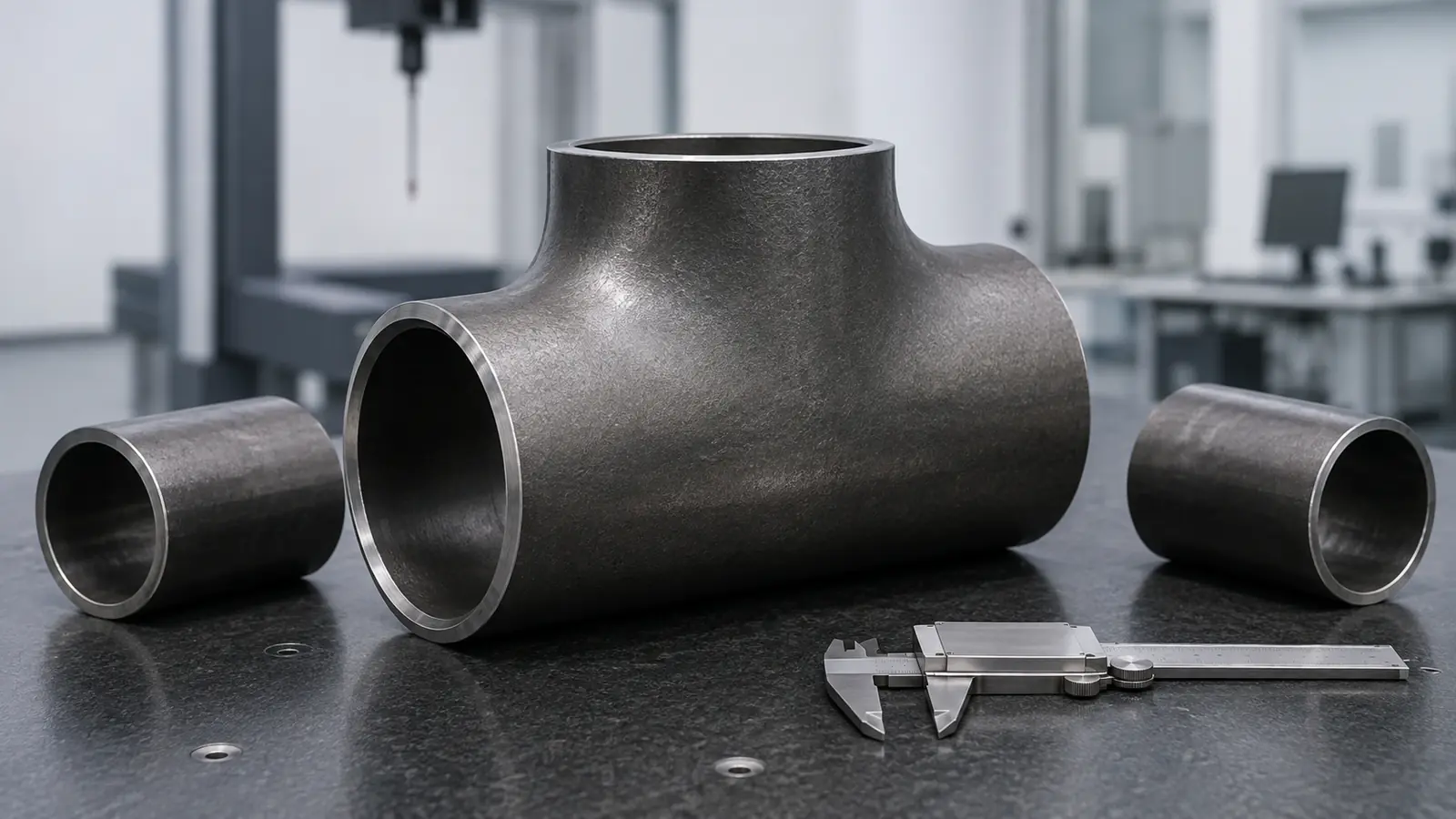
A pipe tee is ready for production only when its product type, three connection sizes, wall arrangement, material specification, dimensional basis, end preparation and acceptance records have been fixed in controlled purchasing documents. These fields must also agree with the piping class, adjoining pipe and approved layout. A description such as “standard carbon steel tee” is not enough: it leaves the manufacturer to interpret details that can change the bore, weld interface, branch position and inspection scope.
The practical test is simple. A production reviewer should be able to identify exactly what will be made, how it will connect at all three openings and what evidence will be used to accept it—without relying on an email thread or an unstated catalogue assumption.
A Tee Creates Three Interfaces, Not One
A straight pipe has two ends. A tee adds a branch, so a single line item controls three interfaces and the geometry between them. The run openings may connect to identical pipe, while the branch can have a different nominal size, wall or downstream function. Even an equal tee, where all three nominal sizes are the same, still requires a defined wall designation and compatible ends.
This is why a tee discrepancy can travel beyond the component itself. A different branch centerline changes spool geometry. A different wall changes the internal bore and may change weld preparation. An ambiguous material description affects both manufacturing and the documents expected at inspection. The errors are related, and they are usually more expensive to correct after forming than during drawing review.
Clean Up Product and Material Identity First
Many incomplete RFQs begin with information copied from the adjoining pipe. That shortcut is understandable, but it can blur the boundary between two different purchased products. Pipe and tees may share nominal size and service conditions while being governed by different dimensional and material requirements.
The phrase “A36 Grade 50 carbon steel pipe” is a good example of an input that needs clarification. ASTM A36/A36M covers structural carbon steel shapes, plates and bars; it is not a pipe or butt-welding fitting material designation. “Grade 50” may point to a different specification family, but the phrase alone does not identify one. Repeating it on a tee purchase order would not create a valid fitting material requirement.
API Specification 5L presents a similar boundary from another direction. It applies to seamless and welded line pipe, covering manufacture, inspection, testing, marking and traceability for that product. An API 5L pipe grade does not automatically become the material grade of the tee connected to it. The piping material specification must state the permitted fitting specification and grade separately.
Before requesting a quotation, resolve the material name into a complete, recognized designation. If the buyer is unsure, the RFQ can state the service conditions and the project’s approved material class, then ask the supplier to identify the offered fitting material for engineering review. What it should not do is combine fragments from structural steel, line pipe and fitting terminology into one unreviewable label.
Translate Pipe Data into a Fitting Requirement
Pipe outside diameter and wall information remain essential because the tee must join the pipe. They are interface inputs, not a substitute for a tee specification. The purchase package should show the nominal pipe size and wall designation for each opening, along with any corrosion allowance or project-specific internal transition.
ASME B36.10 standardizes dimensions for welded and seamless wrought steel pipe. Those pipe dimensions help establish the adjoining outside diameter and bore. They do not define the tee’s center-to-end dimensions or branch geometry. For a conventional factory-made wrought butt-welding tee, those fitting dimensions are addressed by the applicable fitting standard.
The distinction matters most when the branch wall differs from the run. “Equal tee” describes the nominal size arrangement, not necessarily every wall condition. Likewise, “reducing tee” confirms that the branch is smaller but does not tell the manufacturer how the buyer expects a bore transition, heavier wall or internal mismatch to be handled.
A useful production release therefore brings the pipe and fitting data together without confusing their roles. The adjoining pipe schedule establishes the interface. The fitting line identifies the tee itself. The approved drawing shows how the proposed component connects the two.
Maigaotuo’s tee product category provides a useful view of the relevant fitting family. It is a product-discovery step; the controlled line item and drawing still define the exact tee to be manufactured.
Give Each Standard a Defined Job
Adding several standard numbers to an RFQ does not automatically make the item clear. Each reference should answer a particular question. ASME B16.9-2024 covers overall dimensions, tolerances, ratings, testing and marking for factory-made wrought butt-welding fittings within its scope. ASME B16.25-2022 addresses the preparation of butt-welding ends. A selected ASTM fitting specification governs the material and associated manufacturing or test requirements.
The purchase order still has work to do. It selects the tee type, actual sizes, wall, material grade, required standard editions and supplementary project requirements. An approved drawing then records any detail that cannot be communicated safely through a short line description.
This separation prevents a common misunderstanding: the dimensional standard does not choose the material, and the material certificate does not prove the geometry. When the order assigns one clear purpose to each document, suppliers can quote the same scope and inspectors can verify the shipment against the same baseline.
| Release field | What must be fixed | Useful acceptance evidence |
|---|---|---|
| Product identity | Equal or reducing tee; seamless or welded construction when relevant | Item schedule and approved supplier drawing |
| Connection sizes | Agreed order of run, outlet and branch dimensions | Controlled drawing and dimensional record |
| Wall and bore | Wall designation at each opening and any required transition | End-detail drawing and measured results |
| Material | Fitting material specification, grade and supplementary requirements | MTR linked to heat marking and line item |
| Geometry and tolerances | Dimensional standard, edition and project deviations | Approved drawing and dimensional inspection report |
| Ends and surface | Connection type, bevel details and required surface condition | Visual and dimensional inspection records |
| Final document scope | Traceability, inspection, marking, packing and any witness points | Document register and approved inspection plan |
Wall Thickness Is a Weld-Interface Decision
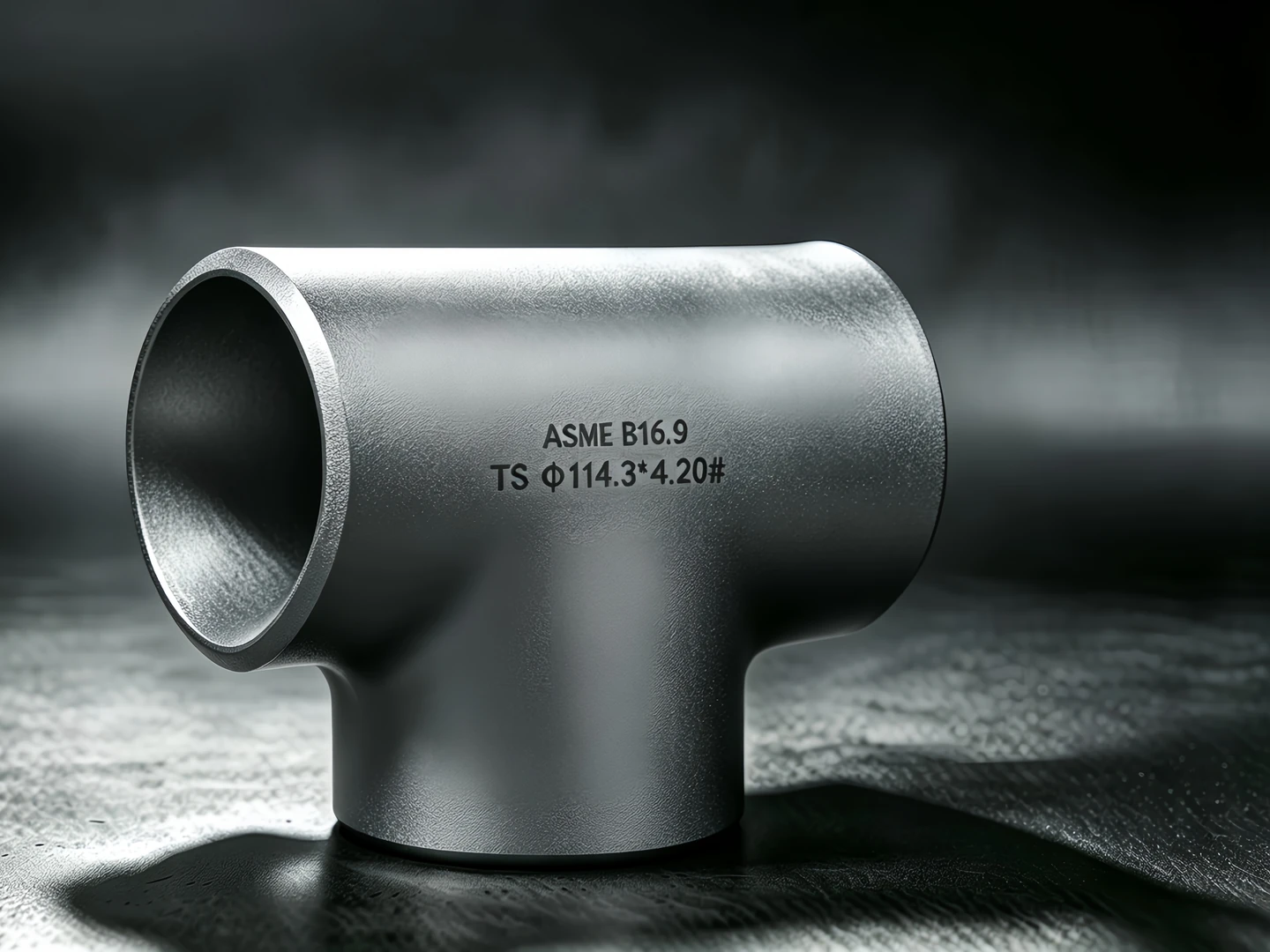
Nominal pipe size identifies a connection family, but it does not determine the internal diameter. As wall thickness increases, the bore normally becomes smaller. At a butt-welded joint, the relationship between the pipe bore, fitting bore and prepared ends influences root alignment and the weld detail available to the fabricator.
A line item that says only “NPS 8 Schedule 40 tee” may be adequate for a straightforward standard item if all three outlets follow the same accepted arrangement. It becomes uncertain when the branch uses another wall, when corrosion allowance must be preserved or when the spool drawing expects a smooth internal transition. In those cases, the supplier needs a section view or an explicit end detail.
A carbon steel equal tee is a relevant product-level reference when all three nominal connection sizes are the same. The page title identifies the product form, but the inquiry must still confirm the actual fitting material specification, wall arrangement and end geometry required by the project.
Mismatch does not always mean the fitting is unusable. Engineering may approve tapering, machining or another transition. The point is that this decision belongs before production release, not at the fabrication bay after the fitting has arrived. A quoted schedule designation and a reviewed bore drawing serve different purposes; critical interfaces may need both.
The same issue affects measurement. Outside diameter alone cannot confirm the bore. If internal alignment is an acceptance concern, the inspection plan must identify which end dimensions will be measured and how the results will be recorded.
Reducing Tee Size Order Must Be Unambiguous
Three numbers can describe a reducing tee, but their order is not self-explanatory across every document or supplier system. The project should state a convention—such as run × outlet × branch—and use it consistently in the material take-off, quotation, drawing, purchase order, marking and packing list.
Relying on “the smallest number is the branch” is risky. A data import, ERP field or abbreviated packing mark may rearrange the sequence. The drawing should identify the run centerline and branch clearly enough that the size order can be checked without interpretation.
This control is especially important for prefabricated spools. The branch location is not an isolated fitting dimension; it establishes the position of a downstream line. If center-to-end geometry or orientation is wrong, adjoining cut lengths and support locations may also be affected. A dimensional report tied to the approved drawing is more useful than a generic certificate of conformity.
Standard Geometry and Project Geometry Are Different Decisions
A standard tee description works when the project accepts the standard product geometry and tolerance. Problems arise when a drawing silently expects something else: a special center-to-end dimension, an offset branch, a non-standard outlet, added machining or a fabricated configuration.
Such requirements are not automatically wrong. They simply need to be identified as project-specific. The supplier can then evaluate manufacturability, testing and timing against the controlled drawing rather than price a catalogue tee and discover the deviation later.
This boundary also keeps quotations comparable. One supplier may price a standard fitting while another recognizes the custom geometry and includes extra work. If the bid tab shows only unit price, the first offer appears cheaper even though the scopes are different. A visible deviation column exposes that difference before commercial evaluation.
Inspection Evidence Must Follow the Acceptance Risk
No single document proves every aspect of a tee. The MTR supports material identity and reported test results for the referenced heat. It does not verify branch position, end bevel or packing condition. A dimensional report confirms recorded measurements, but not chemical composition. Photographs may show surface condition and packing, but they cannot replace traceable material or measured dimensions when those are contractual requirements.
The evidence package should therefore follow the actual risks in the order. A routine standard tee may need normal traceability and dimensional confirmation. A non-standard bore transition may justify drawing approval and targeted end measurements. Supplementary examination, impact testing or third-party witness points belong in the RFQ because they can affect material selection, production route and lead time.
Traceability should remain intact through handling. Heat or batch identification on the fitting must connect with the certificate, line item and packing list. On mixed-size orders, separate bundle identification helps prevent similar-looking components from being assigned to the wrong document set.
Freeze Revisions, Not Just Specifications
A technically complete drawing can still fall short as a production control if the revision is unclear. Changes to branch size, wall, material or inspection scope should update the purchase record and receive supplier acknowledgement. An approved change buried in email does not reliably supersede the drawing used on the shop floor.
Three review points keep the item identity stable. At quotation, the supplier returns the offered specification and all deviations. Before production, both parties approve the line data and drawing revision. Before shipment, the inspection and document package is checked against that same revision.
Late additions deserve careful treatment. Requesting extra examination after forming, or changing the branch wall after material has been allocated, may require more than a document update. The supplier should confirm the effect on manufacture, inspection and delivery before the change is released.
Additional Questions for Tee Procurement
Can different tee configurations share one RFQ line?
Only when every controlled field is identical. A change in size order, wall arrangement, material grade, construction, drawing revision or inspection scope creates a different quotation basis. Separate line items make quantity, marking, documents and deviations easier to trace.
Does the fitting supplier define branch reinforcement for the piping system?
Not by the tee purchase description alone. Branch reinforcement and piping design acceptance belong to the project design basis. If the supplier is expected to perform or support a calculation, the required code basis, design conditions, deliverable and approval responsibility must be stated separately.
When should positive material identification be included?
PMI belongs in the inquiry when the project’s material-control procedure requires it or when the consequences of material mix-up justify additional verification. The RFQ should define the items covered, test method, acceptance criteria, reporting and any witness requirement before suppliers price the inspection scope.
How should mixed-size tee orders be prepared for shipment?
Packing should preserve both physical condition and line-item identity. Bundle or crate markings need to connect each group with the packing list and document set, while protected bevels and separated items reduce handling damage and selection errors at site.
A Release-Ready Tee RFQ
A practical tee RFQ gives every bidder the same release basis. Include the following inputs rather than relying on a short catalogue description:
- tee type and construction, with the agreed run × outlet × branch size convention;
- wall designation at each opening, adjoining pipe data and any controlled bore transition;
- fitting material specification and grade, dimensional and end-preparation standards, and required editions;
- service conditions, controlled drawings, inspection and document scope, marking and packing requirements;
- quantity, required delivery basis and target date.
The supplier’s return should identify the exact offered construction, material, dimensions, end geometry, document package, packing basis and proposed delivery. Standard and project-specific items should be separated, and every exception—whether it concerns material, geometry, examination, documentation or timing—should be declared in the quotation rather than absorbed into an assumed catalogue configuration.
Submit the completed line data and supporting documents through Maigaotuo’s project inquiry page. Once the supplier has returned the offered specification and deviations, compare price and lead time only across technically normalized scopes. The accepted offer can then move into drawing approval and production release without reopening basic product identity.