
What Should Importers Audit Before Approving a Steel Pipe Supplier for Mixed-Specification Orders?
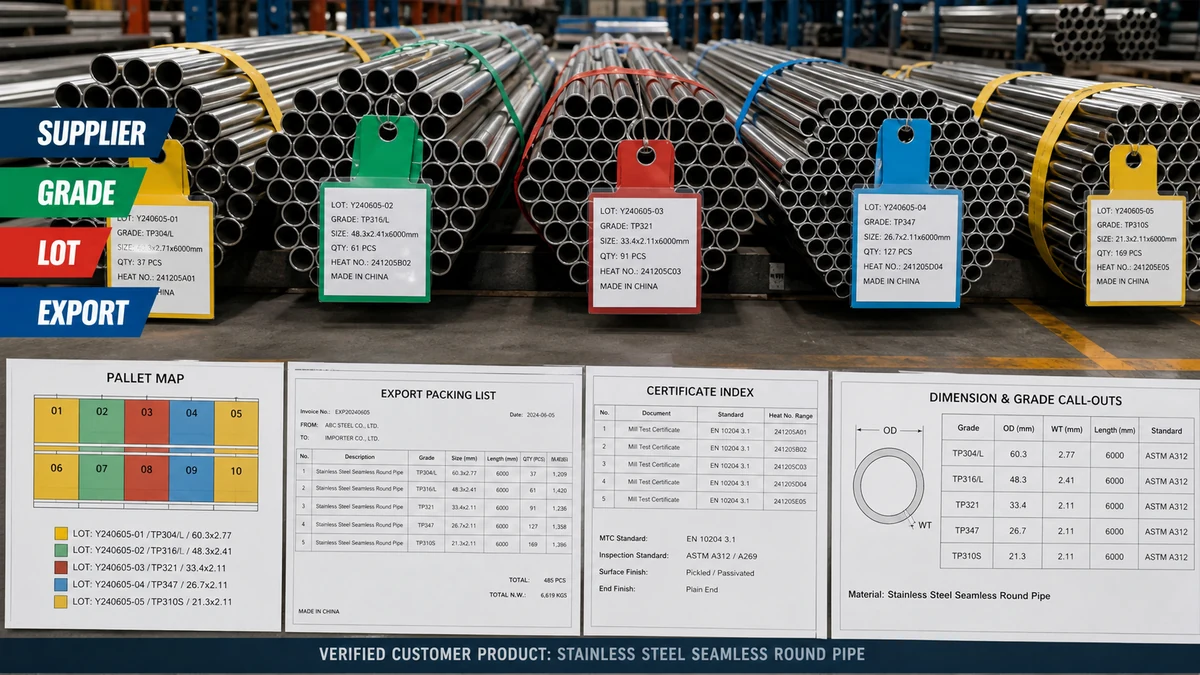
This audit is especially important for steel distributors, EPC contractors, pipeline contractors, equipment manufacturers, and project buyers purchasing carbon steel pipe, stainless steel pipe, coated pipe, and fittings under different standards. Buyers can begin by reviewing the available steel pipes product range, but supplier approval should be based on line-by-line evidence for the actual order rather than on general capability statements.
What Are the Main Audit Gates for a Steel Pipe Supplier?
A mixed-specification order creates more risk than a single-grade shipment because similar-looking materials may require different mills, standards, certificates, processing routes, markings, and packing methods. The supplier must be able to control these differences without losing traceability.
| Audit Gate | Evidence the Importer Should Request | Main Risk if It Is Weak |
|---|---|---|
| Product and standard coverage | A line-item compliance matrix showing product form, standard, grade, size, wall thickness, end condition, coating, quantity, and certificate requirement | Unsupported substitutions or quotations that do not cover the complete order |
| Mill-source control | Original mill identification, certificate review method, approved-source rules, and incoming-material records | Materials from unapproved or untraceable sources entering the shipment |
| Processing control | In-house and outsourced scope for cutting, beveling, threading, galvanizing, coating, bending, testing, and inspection | Quality responsibility becomes unclear after subcontracted processing |
| Lot segregation | Heat-number control, bundle tags, color codes, pallet maps, and packing-list references | Different grades, schedules, or heats are mixed during handling or loading |
| Export documentation | Document index covering MTCs, inspection reports, invoice, packing list, origin documents, shipping marks, and loading records | Customs, client approval, or site acceptance is delayed by inconsistent records |
| Commercial responsibility | Written allocation of responsibility for deviations, replacements, reinspection, repacking, freight, and schedule impact | The importer carries costs that were not visible in the original quotation |
How Should Importers Verify Product and Standard Coverage?
The supplier should not answer a mixed-order RFQ with a single statement such as “all items available.” Importers should issue a structured line-item matrix and require the supplier to classify each item as compliant, proposed deviation, sourced from an external mill, processed by a subcontractor, or unavailable.
Each line should identify:
- Product form, such as seamless pipe, welded pipe, coated pipe, bend, reducer, tee, flange, or cap
- Applicable material and dimensional standards
- Grade, outside diameter, wall thickness or schedule, and length
- Manufacturing route where required
- End condition, including plain, beveled, threaded, or grooved ends
- Surface condition, coating, galvanizing, or lining requirement
- Quantity, tolerances, certificate type, inspection, marking, and packing instructions
How Can Buyers Audit Mill Sources and Certificate Control?
Mixed orders may be consolidated from several mills, stockholders, or processing partners. That is not automatically a problem, but the supplier must show how original material identity is preserved and how incoming certificates are reviewed before the material enters the order.
Importers should ask:
- Which items will come from original mills, existing stock, or external processors?
- Are any mills subject to an approved-source list or project restriction?
- Who checks the material test certificate against the purchase order?
- How are heat numbers connected to pipe markings, bundle tags, and packing records?
- How are rejected or questionable certificates quarantined?
- How are revised certificates controlled so older versions are not used during shipment?
What Processing Capability Should Be Audited?
Importers should audit the processing required by the order rather than relying on a long general capability list. The practical question is not whether a supplier has access to cutting or coating, but whether it can control the exact process, inspection, and identification requirements for the ordered material.
| Processing Step | Buyer Audit Question | Hidden Risk |
|---|---|---|
| Cutting to length | How is heat-number identity transferred to shorter pieces? | Cut lengths become untraceable after original markings are removed. |
| Beveling or threading | How are dimensions, end preparation, and inspection results recorded? | Ends do not match site welding, coupling, or installation requirements. |
| Bending or forming | Who controls material input, forming dimensions, heat treatment, and inspection? | The processed item is supported only by the raw-pipe certificate. |
| Galvanizing or coating | Which party controls surface preparation, thickness, repair, testing, and packaging? | Coating damage, contamination, or unclear inspection responsibility |
| Subcontracted work | Who approves the subcontractor and closes nonconformities? | The trading supplier cannot provide source records or corrective action. |
For example, a project considering spiral steel pipe with internal and external anti-corrosion coating should confirm not only pipe dimensions and grade, but also coating construction, surface preparation, inspection records, marking after coating, handling protection, and repair criteria. These controls affect the delivered condition even when the base pipe is compliant.
How Should Similar Grades and Dimensions Be Segregated?
Lot segregation is one of the most important controls in a mixed container. Carbon and stainless products, different wall thicknesses, different schedules, or different standards can look similar after bundling. If identification becomes hidden or damaged, the importer may not detect a mix-up until unloading, fabrication, or site inspection.
A reliable segregation plan should include:
- Durable bundle tags showing item number, grade, size, heat or lot number, quantity, and package number
- Color codes or secondary identification that do not replace the formal marking system
- Separate bundles or pallets for different grades and schedules
- A packing map showing where each item is positioned in the container
- Loading photos that keep package numbers and labels visible
- An unloading sequence that prevents lower packages from becoming unidentified at destination
- Protection against tag loss, moisture, abrasion, and handling damage
What Export Documents Must Match Before Shipment?
A mixed order should use one document index that links commercial, quality, and logistics records. The importer should not review the invoice, packing list, MTCs, and inspection files separately because inconsistencies usually appear between documents rather than within one document.
Before shipment approval, compare:
- Purchase order and approved line-item compliance matrix
- Commercial invoice and packing list
- Material test certificate index and individual certificates
- Heat-number, bundle, pallet, and package-number records
- Dimensional, coating, NDT, hydrostatic, or other required inspection reports
- Country-of-origin and destination documents required by the order
- Shipping marks, container loading plan, and loading photographs
- Gross weight, net weight, quantity, and package count
What Commercial Risks Are Hidden Behind the Lowest Quotation?
A lower price can reflect genuine sourcing efficiency, but it can also exclude controls needed for a mixed order. Importers should compare the complete supply scope rather than only the price per ton or price per piece.
| Quotation Difference | Possible Short-Term Saving | Potential Importer Cost |
|---|---|---|
| No line-by-line compliance review | Faster quotation | Late discovery of unavailable standards, grades, or dimensions |
| Unspecified mill sources | Lower sourcing cost | Rejected mills, incomplete certificates, or inconsistent product quality |
| Basic packing without segregation map | Lower packing cost | Sorting labor, damaged tags, unloading delays, and site identification problems |
| Processing price without inspection scope | Lower processing quote | Rework, dimensional rejection, coating disputes, or unclear liability |
| Documents prepared after loading | Shorter internal lead time | Shipment delay or inability to correct physical marking and packing errors |
Documents prepared after loading Shorter internal lead time Shipment delay or inability to correct physical marking and packing errors
What Happens in a Typical Mixed-Specification Import Order?
Typical Procurement Scenario: Consolidated Pipe and Fitting Shipment
Business Background: An overseas distributor purchases carbon steel pipe, coated spiral pipe, straight seam pipe, and several fittings in one container. The order contains different standards, wall thicknesses, coatings, and certificate requirements.
Problem: The quotation appears competitive, but the first packing draft groups materials only by outside diameter. Two grades share the same dimensions, several fittings are supplied through a subcontractor, and the coating inspection report is not connected to package numbers.
Cause: The supplier managed purchasing, processing, and packing as separate activities. The commercial team consolidated prices, but no single line-item matrix connected the purchase order to mill sources, processing records, markings, certificates, and packages.
Recommended Solution: Before order release, the importer requires a revised compliance matrix, approved-source list, processing responsibility table, certificate index, heat-number transfer plan, separate bundle identification, and container packing map. The supplier also identifies every subcontracted item and confirms who is responsible for inspection and nonconformance closure.
Buyer decision value: The audit may add coordination before production, but it reduces the higher cost of receiving mixed grades, missing certificates, damaged coatings, incorrect end preparation, or packages that cannot be matched to the order.
How Can Importers Score a Steel Pipe Supplier Before Approval?
A supplier scorecard helps procurement teams compare evidence rather than sales claims. Weighting can be adjusted to the project, but technical and traceability controls should normally carry more importance than presentation quality.
| Audit Area | Suggested Weight | Approval Evidence |
|---|---|---|
| Product and standard coverage | 20% | Completed line-item compliance and deviation matrix |
| Mill-source and certificate control | 20% | Source list, MTC review process, and heat-number traceability |
| Processing and inspection control | 15% | Process scope, subcontractor control, inspection plan, and records |
| Lot segregation and packing | 15% | Tagging method, bundle plan, pallet map, and loading protection |
| Export documents and logistics | 15% | Document index, shipping marks, Incoterm scope, and loading responsibility |
| Commercial transparency and response | 15% | Written exclusions, lead time, MOQ, deviation handling, and corrective-action route |
Commercial transparency and response 15% Written exclusions, lead time, MOQ, deviation handling, and corrective-action route
What Should the RFQ Require From a Steel Pipe Supplier?
To receive comparable quotations, importers should provide:
- A complete line-item list with standards, grades, dimensions, quantities, and tolerances
- Required manufacturing route, end condition, coating, lining, galvanizing, or processing
- Certificate type, inspection reports, third-party inspection, and document language
- Approved-mill or restricted-source requirements
- Heat-number, piece, bundle, pallet, and package-marking rules
- Export packing, moisture protection, container plan, destination, and Incoterm
- Target delivery date and any partial-shipment restrictions
- Rules for substitutions, deviations, subcontracting, reinspection, and nonconformance
Frequently Asked Questions
Can one supplier reliably consolidate several steel pipe standards?
Yes, provided the supplier can demonstrate line-by-line standard coverage, approved mill sources, controlled processing, certificate review, heat-number traceability, and segregated packing. Broad catalog coverage alone does not prove mixed-order control.
Should importers know the original mill for every line item?
The required level of disclosure depends on the contract and project. Importers should at least know whether the material comes from an original mill, stock source, or processor and should define any approved-source restrictions before order placement.
How should outsourced processing be audited?
Confirm the subcontractor, process scope, procedure requirements, inspection method, traceability controls, and responsibility for nonconformities. The main supplier should remain accountable for the agreed supply scope unless the contract states otherwise.
What is the safest way to separate similar pipe grades?
Use durable formal markings, separate bundles, heat and item references, package numbers, color codes as secondary identification, and a packing map. Color alone should not replace grade and heat-number traceability.
When should importers review shipping documents?
Draft documents should be reviewed before loading, while physical markings and packing can still be corrected. Final approval should confirm that invoice, packing list, certificate index, package numbers, shipping marks, and loading records are consistent.
Is the lowest price acceptable for a mixed-specification order?
It may be, but only after confirming that the quotation includes the same material, source, processing, testing, documentation, packing, and responsibility scope. A lower price based on missing controls can create higher total project cost.
What should stop supplier approval immediately?
Unresolved standard deviations, unverifiable mill certificates, lost heat-number traceability, unidentified subcontracting, unclear destination documentation, or refusal to define responsibility for nonconforming material should be treated as approval blockers.
Request a Mixed-Order Supplier Review
For a mixed-specification order review, provide the product list, standards, grades, dimensions, quantities, processing requirements, certificate types, destination, packing expectations, Incoterm, and delivery target through the MGTSP project quotation and supplier review page. Maigaotuo can help organize material matching, processing scope, certificate records, export packing, customs documentation, and shipment planning for the requested order before commercial approval.