
How Should Buyers Specify Carbon Steel Pipe Across ASTM, API, and EN Projects?
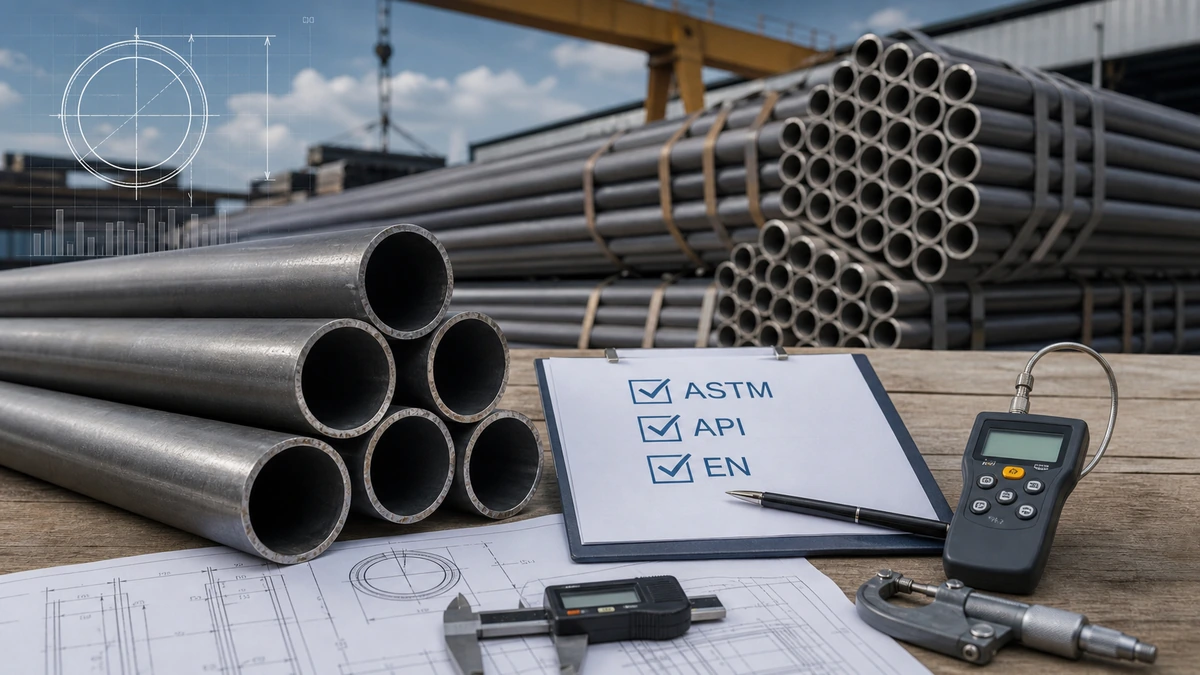
Buyers should specify carbon steel pipe by starting with the service conditions and governing project document, then naming the exact standard, edition, grade, manufacturing route, dimensions, tolerances, testing, inspection certificate, coating, end preparation, marking, packing, and quantity. ASTM, API, and EN designations should not be treated as automatic equivalents without engineering approval.
International pipe inquiries often fail because a buyer sends only an outside diameter, wall thickness, and approximate grade. That leaves suppliers to interpret whether the pipe is for pressure service, line pipe, structural fabrication, mechanical use, or another duty. The resulting quotations may look comparable but include different materials, testing, tolerances, and documentation.
Start With the Service, Not a Familiar Grade
Before selecting a standard, define:
- Transported medium or structural function.
- Design and operating pressure.
- Design and operating temperature.
- External loads and installation method.
- Corrosion conditions.
- Sour, low-temperature, cyclic, or other special service.
- Welding and fabrication route.
- Governing design code and client specification.
- Destination-country requirements.
The buyer’s responsible engineer should determine the applicable material specification. A supplier can help identify available products, but should not be asked to replace the project design basis with a generic “equivalent.”
Standards Family Decision Table
| Project language | Buyer action | Supplier response required |
|---|---|---|
| ASTM-based specification | State the exact ASTM designation, grade, edition, supplementary requirements, and project code | Quote the same callout or clearly list every deviation |
| API-based pipeline specification | State the API product specification, level or grade where applicable, service additions, and required tests | Confirm manufacturing route, product level, testing, marking, and documentation |
| EN-based specification | State the exact EN product standard, steel designation, delivery condition, dimensions, and inspection document | Confirm the same designation and all ordered options |
| Cross-standard substitution | Provide a formally approved substitution rule or request an alternative proposal | Supply a side-by-side technical comparison; never label a grade “equivalent” without qualifications |
Standards cover more than chemistry. They may differ in mechanical properties, dimensions, tolerances, heat treatment, test frequency, inspection documents, marking, and permitted manufacturing processes.
1. Define the Product Form and Manufacturing Route
State whether the requirement is for:
- Seamless pipe.
- Electric-resistance-welded pipe.
- Longitudinally or spirally welded pipe.
- Structural round, square, or rectangular section.
- Bare, galvanized, lined, or coated pipe.
The acceptable route should follow the governing specification and service. If more than one route is acceptable, ask suppliers to quote each as a separate alternative instead of blending them into one line item.
Maigaotuo’s Steel Pipes category covers round pipe, square tube, rectangular tube, and special-shaped tube sourcing. The final product selection still depends on the exact project callout.
2. Specify Dimensions in One Unambiguous System
An RFQ should identify:
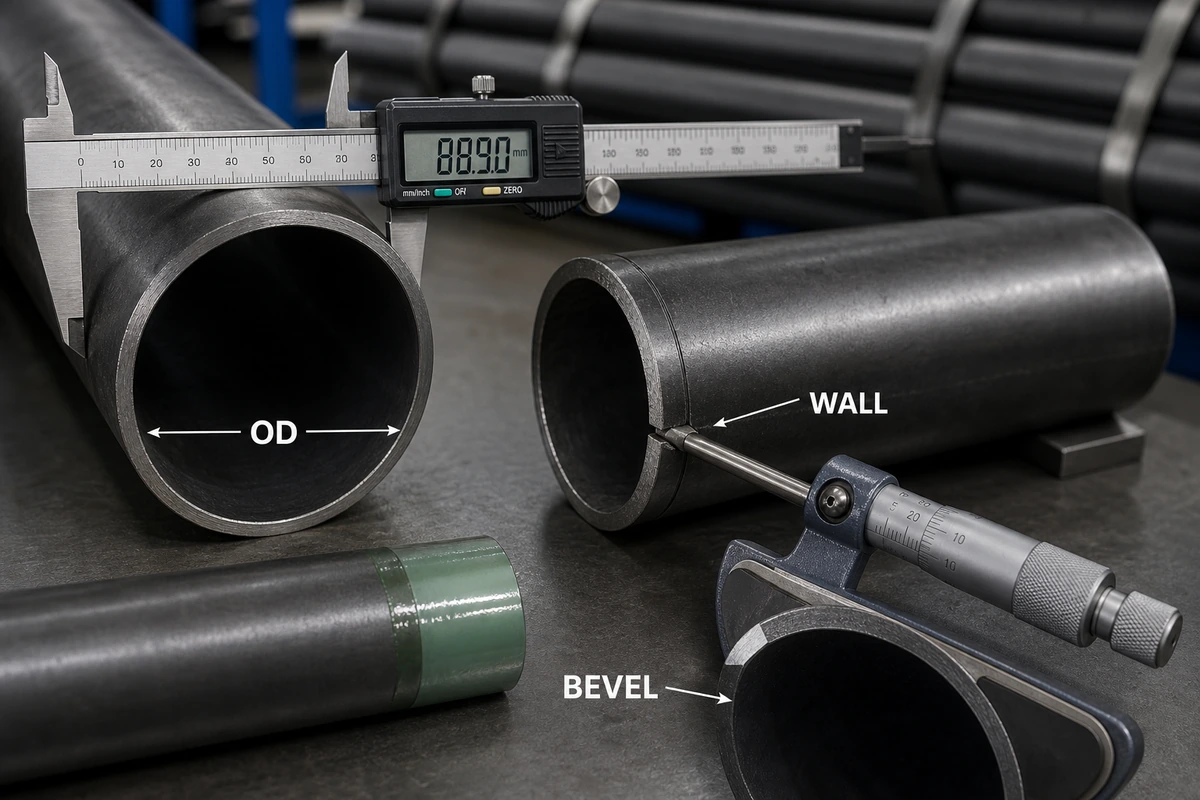
- Nominal pipe size or outside diameter.
- Wall thickness or schedule.
- Length and permitted length variation.
- End finish.
- Dimensional standard.
- Quantity by size.
- Unit of measure.
- Required tolerances beyond the base standard.
Do not mix NPS, DN, outside diameter, schedule, and millimeters without a clear mapping. A schedule number is not a universal wall thickness across every nominal size. If the project drawing controls, attach it and identify the revision.
3. Separate Grade Selection From “Equivalent” Discussion
When the original specification names one standard and the supply market uses another, create a comparison table that includes:
- Full designation and edition.
- Product type and permitted manufacturing route.
- Chemical-composition limits.
- Yield and tensile requirements.
- Impact requirements and test temperature.
- Heat-treatment or delivery condition.
- Dimensional tolerances.
- Hydrostatic, nondestructive, or other testing.
- Inspection-document type.
- Marking and traceability.
An alternative should be submitted for engineering review before purchase. Similar strength values alone do not establish interchangeability.
4. State Testing and Document Requirements Line by Line
The RFQ should distinguish mandatory requirements from optional inspection services.
| Documentation or test | What to state |
|---|---|
| Mill test certificate | Required format, standard, heat number, chemistry, mechanical results, and traceability |
| Nondestructive testing | Method, coverage, acceptance basis, and report requirement |
| Hydrostatic testing | Governing specification and whether records are required |
| Dimensional inspection | Sampling plan, reported dimensions, and tolerances |
| Third-party inspection | Agency, witness/hold points, scope, and report language |
| Coating inspection | Surface preparation, thickness, holiday test, adhesion, or other project requirements |
| Positive material identification | Locations, sampling, method, and reporting if required |
Do not request every test by default. Each added test changes cost, scheduling, and document control. Specify only what the project requires, but make those requirements visible before quotation.
5. Define Surface, Coating, Ends, and Fabrication
Include:
- Bare, oiled, painted, galvanized, or project coating system.
- Surface-preparation requirement.
- Coating areas and excluded areas.
- Plain, beveled, threaded, grooved, or coupled ends.
- Bevel geometry and root face where controlled.
- End caps or thread protectors.
- Cut lengths, holes, bending, or prefabrication.
- Required marking method.
If pipes and fittings will be consolidated, provide a bill of materials and identify matching pressure class, dimensions, material callouts, and end connections. Maigaotuo also supplies industrial pipe fittings for consolidated procurement discussions.
6. Protect Traceability Through Packing and Shipping
For export orders, state:
- Bundle size and maximum weight.
- Separation by heat, grade, or size.
- Tag information.
- End protection.
- Waterproofing or seaworthy packing requirement.
- Container-loading constraints.
- Destination port.
- Required shipping and customs documents.
- Whether mixed products may share a shipment.
The packing list should preserve the relationship between the delivered bundle and its material documents.
Carbon Steel Pipe RFQ Template
Service and design basis
- Application:
- Medium or structural duty:
- Design pressure and temperature:
- Operating pressure and temperature:
- Corrosion or special service:
- Governing design code:
- Project/client specification:
Material and dimensions
- Standard and edition:
- Grade and delivery condition:
- Manufacturing route:
- NPS/DN/OD:
- Wall thickness or schedule:
- Length:
- Quantity by size:
- Dimensional standard and additional tolerances:
Testing and documents
- Inspection certificate/MTC:
- NDT:
- Hydrostatic test:
- Impact test:
- PMI:
- Third-party inspection:
- Required report language:
- Traceability and marking:
Finish and delivery
- Surface or coating:
- End preparation:
- Cutting or fabrication:
- Packing:
- Destination:
- Delivery schedule:
- Trade terms:
Confirm the Commercial Line Items
Request separate quotation lines for each pipe form, grade, size, end preparation, coating, inspection level, and document package. The supplier should state minimum order quantity, mill or stock availability, production and inspection lead time, marking, bundling or seaworthy packaging, customization limits, delivery terms, and quote validity. Price comparisons should normalize steel grade, weight basis, dimensional tolerance, testing, third-party inspection, coating, documentation, packing, and freight rather than compare an unexplained price per tonne.
Frequently Asked Questions
Can an ASTM grade be replaced by an EN grade with similar strength?
Not automatically. Compare the complete product specification, manufacturing route, chemistry, mechanical properties, delivery condition, testing, tolerances, documents, and governing design code. Obtain formal engineering approval.
Is schedule enough to define wall thickness?
No. State nominal size together with schedule or provide the actual wall thickness and governing dimensional standard.
What is the most important document for traceability?
The required inspection certificate or mill test certificate is central, but it must connect to the pipe through heat numbers, product markings, bundle tags, and packing records.
Should buyers accept a supplier’s “equivalent grade” statement?
Treat it as an alternative proposal, not approval. Request a documented comparison and route it through the project’s technical approval process.
What information produces the fastest reliable quotation?
Provide the governing standard, grade, dimensions, quantities, manufacturing route, testing, coating, ends, inspection documents, packing, destination, and required delivery date.
Request an International-Standard Pipe Quotation
Maigaotuo supplies steel pipes, sections, fittings, plates, stainless-steel products, and mesh with processing and export-service support. Send the completed RFQ, bill of materials, project standard, drawings, inspection requirements, destination, and schedule through the Maigaotuo contact page. All standards, grades, documents, and deviations should be confirmed in the final quotation.