


Concentric vs Eccentric Reducer: How to Choose for Piping Systems
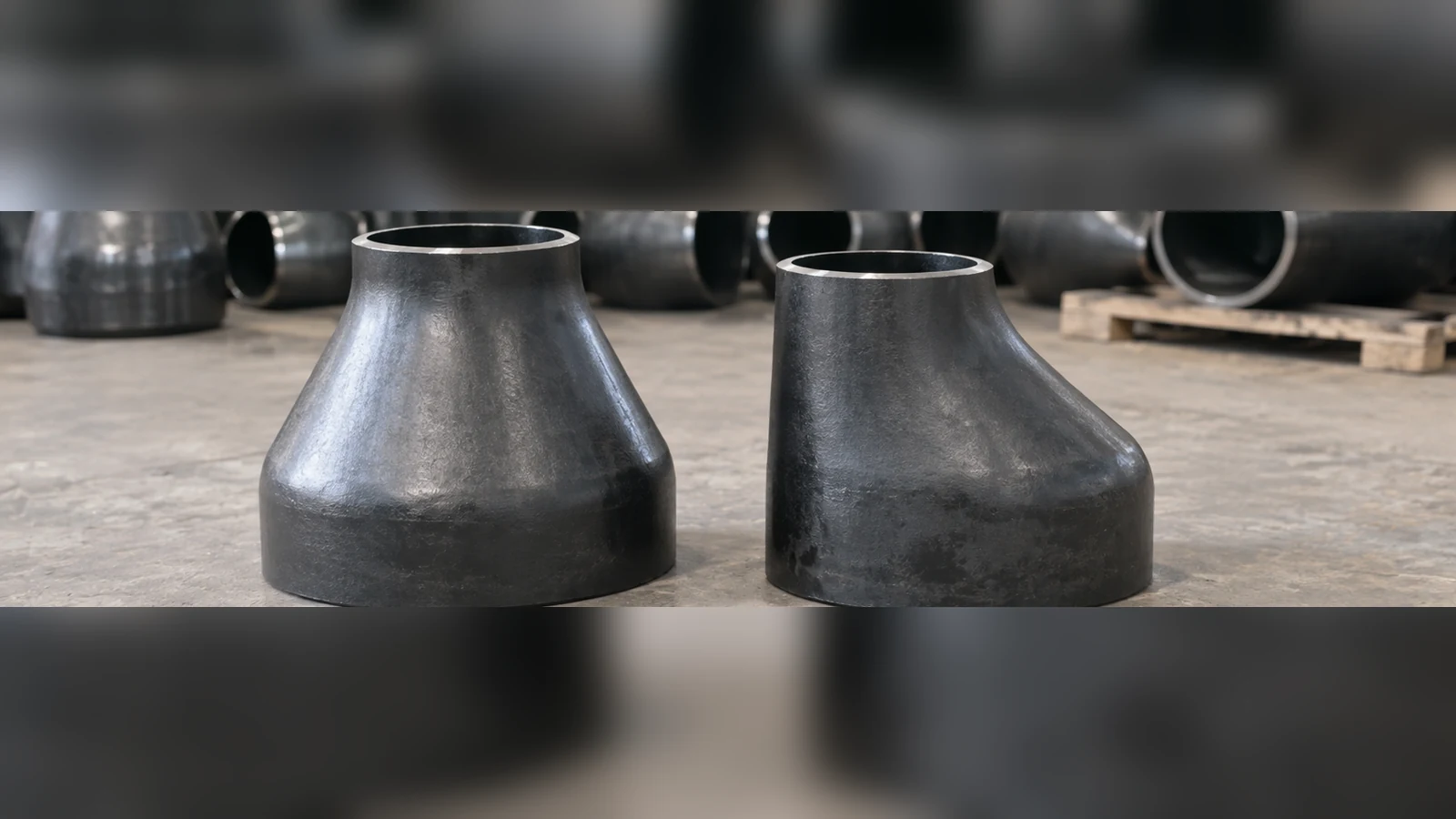
A concentric reducer and an eccentric reducer both connect pipes of different sizes, but their centerlines are different. A concentric reducer keeps the two openings on the same axis. An eccentric reducer offsets them so one side can remain level. The right choice depends on piping orientation, liquid or gas service, pump requirements, drainage, available space and the project’s piping specification. Before ordering, confirm not only the large and small ends but also wall thickness, material grade, fitting standard and—in eccentric installations—the required flat-side orientation.
MGTSP lists eccentric reducer fittings and stainless steel reducers among its pipe-fitting products. Their precise geometry, grade and dimensions still need to be matched to the project documents. This guide explains how to make that selection and prepare an accurate inquiry.
What Is the Difference Between Concentric and Eccentric Reducers?
In a concentric pipe reducer, the centers of the large and small circular openings lie on one common axis. The reduction in diameter is therefore distributed around the circumference. In an eccentric reducer, the centers are displaced, creating a straight—or nearly straight—side. A reducer is not a valve, an anti-vibration component or an automatic solution to poor piping layout; it is a change in pipe size that must be considered within the system.
| Comparison | Concentric reducer | Eccentric reducer |
|---|---|---|
| End centerlines | Aligned | Offset |
| Typical geometry | Symmetric taper | One approximately straight side |
| Common layout consideration | Maintaining a common pipe axis | Maintaining a pipe top or bottom elevation |
| Installation orientation | No flat-side orientation | Orientation must be shown on the drawing |
| Selection basis | Service, dimensions and piping design | Service, dimensions, flow behavior and flat-side position |
Neither option is universally better. A fitting that matches the specified diameters but conflicts with the intended pipe elevation or equipment connection can create an installation problem.
When Should You Use a Concentric Reducer?
A concentric reducer is worth considering when the layout needs the large and small pipes to share a centerline. This can simplify a coaxial connection and is commonly encountered in vertical runs and layouts where an offset is unnecessary. The choice still depends on the medium, the need to vent or drain trapped fluid, and the arrangement of nearby supports and equipment.
Vertical and Coaxial Pipe Connections
With a vertical pipe, the axis may be the most important geometric reference. A concentric reducer can keep both connected pipe sections on that axis. This does not make it the automatic choice for every vertical installation: the engineer must still account for fluid service, installation clearances and local project rules.
Where a Straight Pipe Axis Matters
In a line approaching a vessel or a piece of equipment, check whether a symmetric transition places the smaller pipe at the correct center height. If it does not, an eccentric geometry may be more appropriate, or the surrounding pipe supports may need to change.
When Should You Use an Eccentric Reducer?
An eccentric reducer is useful where one side of a horizontal line needs to remain at a fixed elevation. The flat side can face upward or downward, but the correct direction is a design decision, not a universal installation rule. An eccentric reducer can be selected to help address potential high or low pockets in a given service; the exact arrangement must be reviewed in the system context.
Eccentric Reducers in Horizontal Pipelines
Compare the pipe invert and crown levels on the drawing. If the layout requires the pipe bottom to remain level, a flat-bottom arrangement may be considered. If maintaining the upper elevation addresses a particular vapor-pocket concern, a flat-top orientation may be considered. The actual flow direction, fluid state and drainage or venting points determine whether that geometry is suitable.
Reducers Near Pump Suction Connections
For a liquid pump suction line, unintended high points can contribute to gas accumulation under some operating conditions. Engineers therefore pay particular attention to the suction-line layout, including the reducer and upstream straight runs. The pump maker’s instructions and applicable project design requirements take priority: not every pump service or inlet geometry requires the same eccentric arrangement.
Flat on Top vs Flat on Bottom
| Orientation | What it preserves | What to check |
|---|---|---|
| Flat on top (FOT) | Approximate upper pipe elevation | Potential high pockets, pump or vessel connection and service details |
| Flat on bottom (FOB) | Approximate lower pipe elevation | Drainage, suspended solids, low pockets and equipment clearances |
Those are geometric descriptions, not rules that guarantee trouble-free flow. Do not choose orientation from a generic photo; verify the piping isometric and equipment notes.
What Reducer Dimensions and Materials Must Be Specified?
Large End, Small End and Wall Thickness
State both end sizes using the specified dimensional system. Nominal pipe size (NPS) or DN is not interchangeable with a measured outside diameter without the proper reference. Confirm each end’s wall thickness or schedule, the transition length, end preparation and any permitted dimensional tolerances. The adjoining pipes must be compatible with both ends of the fitting.
Material Selection: Carbon Steel or Stainless Steel
Choose the grade for the process medium, temperature and piping specification. Corrosion resistance cannot be inferred from the generic label “stainless steel.” MGTSP’s stainless steel reducer listing refers to grades including 304 and 316 and describes both concentric and eccentric configurations. Buyers should request the exact grade, applicable material specification and documents needed for the ordered item, rather than assuming that every listed option is in stock.
Fitting Standards and Material Standards
Separate dimensional requirements from material requirements. For example, ASME B16.9 is commonly referenced for factory-made wrought butt-welding fitting dimensions, while a separate material specification determines the allowable product material. Where an EN or another national system governs the project, use that specified document and revision instead of mixing dimensions from one system with certification language from another.
Common Pipe Reducer Selection Mistakes
- Ordering by two diameters alone: Missing wall thickness, end preparation or standard can make the fitting unsuitable.
- Confusing DN with outside diameter: Verify the dimensional designation instead of treating the number as a measured millimeter diameter.
- Leaving eccentric orientation unspecified: Include the required FOT or FOB direction and the piping drawing when relevant.
- Ignoring equipment interfaces: Check pipe elevations, weld access, supports and equipment-nozzle requirements.
- Assuming a listed alloy fits the service: Confirm corrosion, temperature and material documentation against the intended medium.
What Should Buyers Include in a Reducer RFQ?
For international piping procurement, a clear RFQ helps a supplier distinguish a design requirement from a general product inquiry. MGTSP organizes reducer fittings within its pipe-fitting range, but project conformity must be agreed for each ordered fitting.
| RFQ item | Information to supply |
|---|---|
| Geometry | Concentric or eccentric; FOT/FOB if applicable |
| End dimensions | Large and small nominal sizes, outside diameters where relevant |
| Wall and ends | Schedule or wall thickness, welding end requirements |
| Materials | Material grade and applicable material specification |
| Applicable rules | Fitting dimensional standard, revision and project deviations |
| Documentation | Material test certificate and inspection requirements if needed |
| Order scope | Quantity, required date, delivery destination and drawing reference |
Share the isometric or fitting drawing where the offset direction is relevant. Ask for clarification before placing an order if any two documents disagree.
Frequently Asked Questions
Can an eccentric reducer replace a concentric reducer?
Not automatically. Although both connect different pipe sizes, their centerlines and required installation space differ. Check the drawing, line elevations and operating conditions before approving a substitution.
Does an eccentric reducer always need a flat-top installation?
No. Flat-top and flat-bottom refer to different orientations, and the project engineer must choose based on the line arrangement, process medium and equipment requirements.
Are concentric and eccentric reducers available in the same nominal sizes?
Many nominal size combinations may be offered in either configuration, but the actual dimensional range, wall thickness and material must be verified with the supplier for the project.
Final Selection Considerations
Choose the geometry first from the piping layout, then verify dimensions, material, end connections and required documentation. A correct size transition is one that fits the entire line—not merely the two nominal diameters. To review a specific requirement, send MGTSP the reducer drawing, sizes, material grade and required quantity for configuration and quotation discussion.