



09G2S Low Temperature Welded Steel Pipe: How to Verify Grade, Dimensions and Mill Certificates
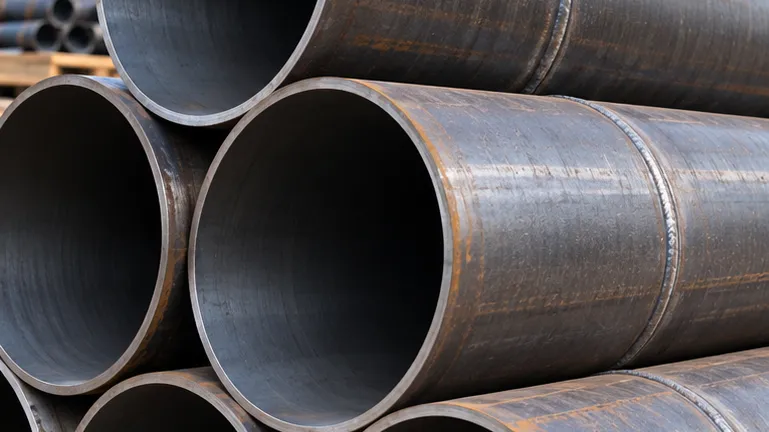
A 09G2S low temperature welded steel pipe RFQ is not complete when it contains only a material grade and a nominal pipe size. For a project quotation to be technically comparable, the buyer should connect the material requirement, governing pipe or project specification, exact outside diameter, wall thickness, length, end preparation and inspection/document scope. Low-temperature service adds another decision: whether the project requires toughness testing at a defined temperature and how the result must be documented. If these points are left open, two suppliers can quote “09G2S welded pipe” while actually offering different pipe dimensions, testing scope and traceability.
Maigaotuo / MGTSP lists Russian St and 09G2S grades among the material options for its Straight Seam Steel Pipe. The same product page identifies standard-stock sizes from DN15 to DN200, thin-wall and heavy-wall custom options, standard 6 m length, plus cut-to-length, threading and beveling services. Those facts make the product family relevant to 09G2S procurement, but the final project still needs to define the exact grade, dimensions, low-temperature acceptance conditions and document requirements.

What Does “09G2S Low Temperature Welded Steel Pipe” Actually Specify?
The search phrase combines several decisions that are often treated as if they were one. 09G2S is a material grade designation. Welded steel pipe identifies the product form and manufacturing family. Low temperature describes a service or acceptance condition that may trigger additional toughness, inspection or documentation requirements. None of those terms automatically fills in the others.
This is why a buyer searching for 09G2S welded steel pipe dimensions should not start with a generic catalog table alone. The project needs a pipe-product standard, piping specification, drawing or other controlled document that establishes the dimensional basis and acceptance conditions. The grade name by itself does not tell a supplier which outside diameter, wall thickness, tolerance, test temperature, certificate format or end condition is required.
Procurement boundary: do not convert the phrase “low temperature” into an assumed service-temperature rating. The project design temperature and any required toughness evidence should come from the governing specification or approved engineering requirement.
Lock the Pipe Size and 09G2S Welded Pipe Wall Thickness First
For purchasing, nominal size is only a starting point. A usable RFQ should identify the nominal pipe size system, outside diameter, wall thickness, length and quantity. If the project schedule uses DN while the mill or trader quotes outside diameter in millimeters, the RFQ should show the intended dimensional relationship so both sides are evaluating the same product.
The 09G2S welded pipe wall thickness deserves its own line because nominal size does not define one universal wall. Wall thickness changes pipe mass, internal bore, material consumption, end preparation and the geometry of adjoining fittings. It may also affect which test conditions apply under the governing project requirement. “DN100 09G2S pipe” is therefore not a complete order description.
Length should be treated with the same discipline. MGTSP lists 6 m as a standard fixed length and also lists cut-to-length processing. A buyer using fabricated spools, structural assemblies or equipment skids should state required finished or supply length by line item instead of assuming standard mill length will work.
Do Not Mix Material Grade, Pipe Standard and Manufacturing Route
One recurring sourcing problem is using a familiar material name as if it were the complete pipe specification. A material grade answers the question “what steel?” The pipe or project standard answers other questions such as dimensional basis, tolerances, inspection requirements and manufacturing conditions. A fabrication drawing may add another layer by defining special length, end condition, marking or acceptance details.
This distinction also matters when a buyer compares different welded-pipe production routes. If a project permits more than one manufacturing route, the RFQ should ask suppliers to list alternatives separately. A quotation should not silently substitute another route simply because the same nominal grade is available. Otherwise the buyer may compare prices without realizing that the product form, inspection basis or dimensional range has changed.
Do Not Treat “Equivalent Grade” as Automatic Purchase Approval
International steel sourcing frequently involves cross-reference tables between GOST, EN, ASTM, JIS and Chinese designations. These tables are useful for preliminary screening, but they do not automatically prove that two grades are interchangeable in a specific low-temperature welded-pipe application. Chemical composition, delivery condition, strength level, toughness category and inspection requirements can differ even when a commercial table lists two materials as “equivalent.”
If the original project calls for 09G2S, the quotation should either repeat 09G2S or clearly identify a proposed substitute as a deviation. The buyer can then route that deviation for technical approval. This prevents a commercial substitution from becoming an unrecorded engineering decision.
When Should Buyers Request a Low Temperature Welded Steel Pipe Impact Test?
A low temperature welded steel pipe impact test becomes relevant when the governing material standard, piping specification, project requirement or engineering document requires toughness verification at a defined temperature. The key point is that “impact test required” is still incomplete unless the RFQ also identifies the test temperature, acceptance basis, reporting requirement and any lot or heat traceability expected by the project.
The buyer should separate three questions:
- Is impact testing required? Identify the source of the requirement.
- At what condition? State the required test temperature and applicable acceptance basis exactly as defined by the project.
- What evidence is required? State whether the result must appear on the material certificate, a separate test report or another controlled inspection document.
This avoids a common mistake: copying a test temperature from another project because the same grade name appears. Low-temperature requirements are project-specific and should be verified against the actual governing documents.
How to Review an 09G2S Welded Steel Pipe Mill Certificate
An 09G2S welded steel pipe mill certificate should be reviewed as part of a traceability chain rather than as an isolated PDF. The certificate should correspond to the ordered material and to the actual pipe lot being shipped. Procurement teams should compare the purchase order, grade, dimensional description, heat or lot identification, required test results and physical marking information.
The strongest check is a three-way match. First, compare the certificate against the purchase order: grade, specification, dimensions and required testing. Second, compare the certificate against the bundle or pipe identification: heat or lot reference, size and quantity. Third, compare both with the inspection or packing record used for shipment release. Any mismatch should be resolved before the material is accepted for fabrication or loading.
For 09G2S steel pipe traceability, the practical question is simple: can the buyer connect the material identity on the document to the physical pipe without relying on an informal spreadsheet or someone’s memory? Heat references, bundle tags and inspection records add value only when they form one consistent chain.
When Is an NDT Report Relevant?
Search demand around a straight welded steel pipe NDT inspection report reflects a real buyer concern, but NDT should not be turned into a generic promise that every 09G2S welded-pipe order includes the same inspection method or acceptance level. The required method, coverage, acceptance criteria and reporting scope should come from the applicable pipe standard or project inspection plan.
If NDT is required, the RFQ should identify the expected method and evidence. The quotation should then state whether the inspection is included, who performs it, and how the report is linked to the supplied lot. This makes supplier quotations comparable on inspection scope instead of on vague phrases such as “tested before shipment.”
End Preparation Changes the Commercial Scope
End condition often appears to be a fabrication detail, but it can materially change the purchase scope. MGTSP lists threading and beveling among available processing services for straight-seam steel pipe. If the project requires field welding or shop welding, the RFQ should identify whether pipe ends are plain, threaded, beveled or controlled by a drawing or welding procedure.
“Standard bevel” is not a complete acceptance requirement when the WPS or project drawing controls the joint. The supplied bevel, root face and any transition at heavy-wall connections need to match the welding plan. The safe approach is to attach the controlled drawing or reference and ask the supplier to confirm exactly what end preparation is included.
Why Two 09G2S Welded Pipe Quotations May Not Be Comparable
Two suppliers can quote the same material grade but include very different work. One quotation may cover standard 6 m pipe with plain ends and basic material documentation. Another may include cut lengths, beveling, additional low-temperature testing, special marking and a document package tied to heat numbers. Comparing only price per ton hides those scope differences.
| RFQ Item | Buyer Should Define | Supplier Should Confirm | Decision Impact |
|---|---|---|---|
| Material identity | 09G2S plus governing requirement | Quoted grade and applicable standard | Prevents unapproved substitution |
| Pipe dimensions | DN/NPS or OD, wall, length, quantity | Offered dimensions and assumptions | Controls fit, mass and fabrication |
| Low-temperature acceptance | Required test condition where applicable | Included testing or declared deviation | Separates grade name from verified requirement |
| Inspection evidence | MTC/NDT/test-report scope | Document list linked to supplied lot | Makes quotations technically comparable |
| End preparation | Plain, threaded, beveled or drawing-controlled | Included processing | Affects downstream fit-up |
| Identification | Required marking and traceability | Heat/lot and packing ID method | Supports receiving inspection |
Turn the Quotation Into a Technical Comparison Sheet
After suppliers respond, procurement should normalize the offers before comparing price. Create one comparison sheet with the same fields used in the RFQ and copy each supplier’s response into a separate column. Do not leave a blank field as “assumed compliant.” A blank should be treated as unconfirmed until the supplier states the offered grade, dimensional basis, testing scope or processing scope.
This is particularly important when one quotation uses a short commercial description such as “09G2S welded pipe, standard quality” while another lists the full size, wall, length, heat-number traceability, inspection documents and end preparation. The second offer may look more expensive because it includes work that the first quotation has not priced. Normalizing the scope exposes that difference before purchase rather than after the material reaches the fabrication shop.
Where an alternative is commercially attractive, keep the base-compliant offer and the alternative offer separate. That gives engineering a clear deviation to review and prevents an approved exception from being confused with the original specification.
Receiving Inspection Should Close the Same Traceability Loop
The procurement process is not complete when the purchase order is issued. At receipt, the warehouse or project quality team should compare the delivered bundles against the same technical fields that controlled the order: grade identification, size, wall thickness, length, quantity, heat or lot reference, required end condition and document package. This closes the traceability loop from RFQ to quotation to purchase order to physical delivery.
If the project requested additional low-temperature testing or NDT records, those documents should be checked against the same heat or lot identifiers used on the material certificate and bundle marks. If cut lengths or beveling were ordered, receiving inspection should also verify that those processing requirements are present before the material is released to fabrication. This prevents a common problem in international steel purchasing: technically correct paperwork arriving with material that cannot be reconciled to the ordered line items.
For buyers managing several pipe sizes or multiple heats, a simple receiving matrix can be more effective than a long narrative report. One row per line item or bundle, with columns for purchase-order item, size, wall, heat/lot, certificate reference and acceptance status, gives the project team a visible record of what was actually received and what still needs clarification.
Use the Product Page for Shortlisting, Then Freeze the Order in the RFQ
The Steel Pipes category and Straight Seam Steel Pipe page are useful for confirming that MGTSP supplies the relevant product family and lists 09G2S among its material directions. They are not substitutes for the controlled project specification.
Before requesting a final price, send a line-by-line schedule covering grade, standard, outside diameter, wall thickness, length, end condition, quantity, low-temperature testing requirement, certificate/inspection scope and marking. If alternatives are allowed, request them as separate line items rather than allowing substitutions to appear silently inside the base quotation.
Buyers can send drawings, specifications and document requirements through the Maigaotuo inquiry page. The most useful supplier response is not just a number; it is a quotation that repeats the technical basis, exposes deviations and makes the 09G2S material, dimensions and evidence comparable before purchase.