


Specification Briefing 2026: Why Stainless Steel Razor Wire Is No Longer a Commodity Purchase for Global Perimeter Security
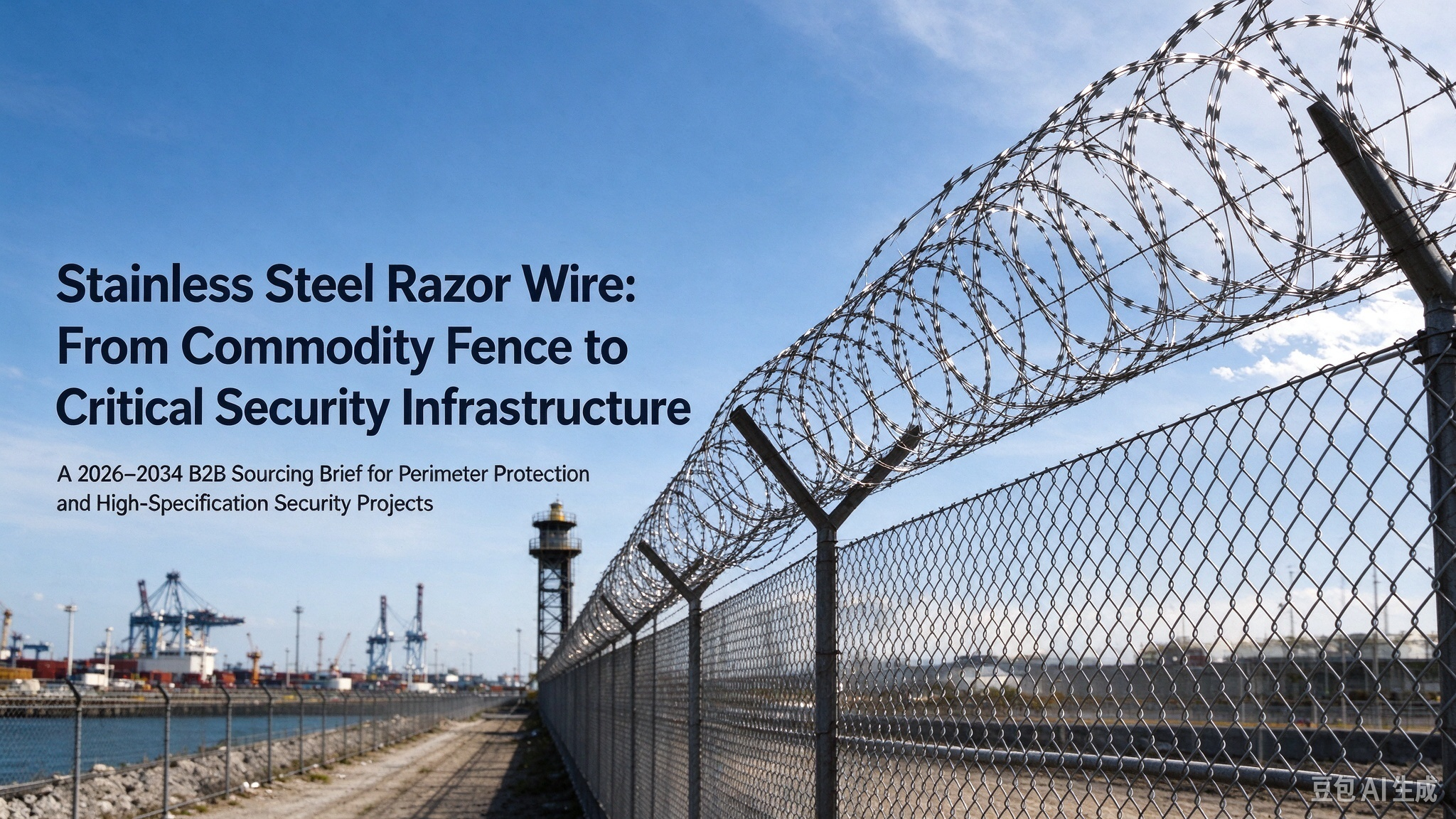
For procurement managers and security specifiers, razor wire has long occupied an awkward category: essential for perimeter protection, but rarely subjected to the same scrutiny as cameras, access control systems, or surveillance software. That is changing. In 2026, the specification of stainless steel razor wire is being re-evaluated not as a commodity fencing accessory, but as a long-lifecycle security asset whose material grade determines whether a project’s perimeter holds up in coastal humidity, industrial pollution, or extreme weather.
The market data reflects this reorientation. The global razor wire market was valued at approximately US$320 million in 2025 and is projected to reach US$540 million by 2034, growing at a compound annual growth rate of 5.8%. Growth is not being driven by volume alone. It reflects a shift toward higher-specification materials—particularly stainless steel—as buyers in Europe, North America, and the Middle East prioritize corrosion resistance, service life, and reduced maintenance cycles over initial unit cost.
The Material Question: 304 vs. 316 in Real-World Environments
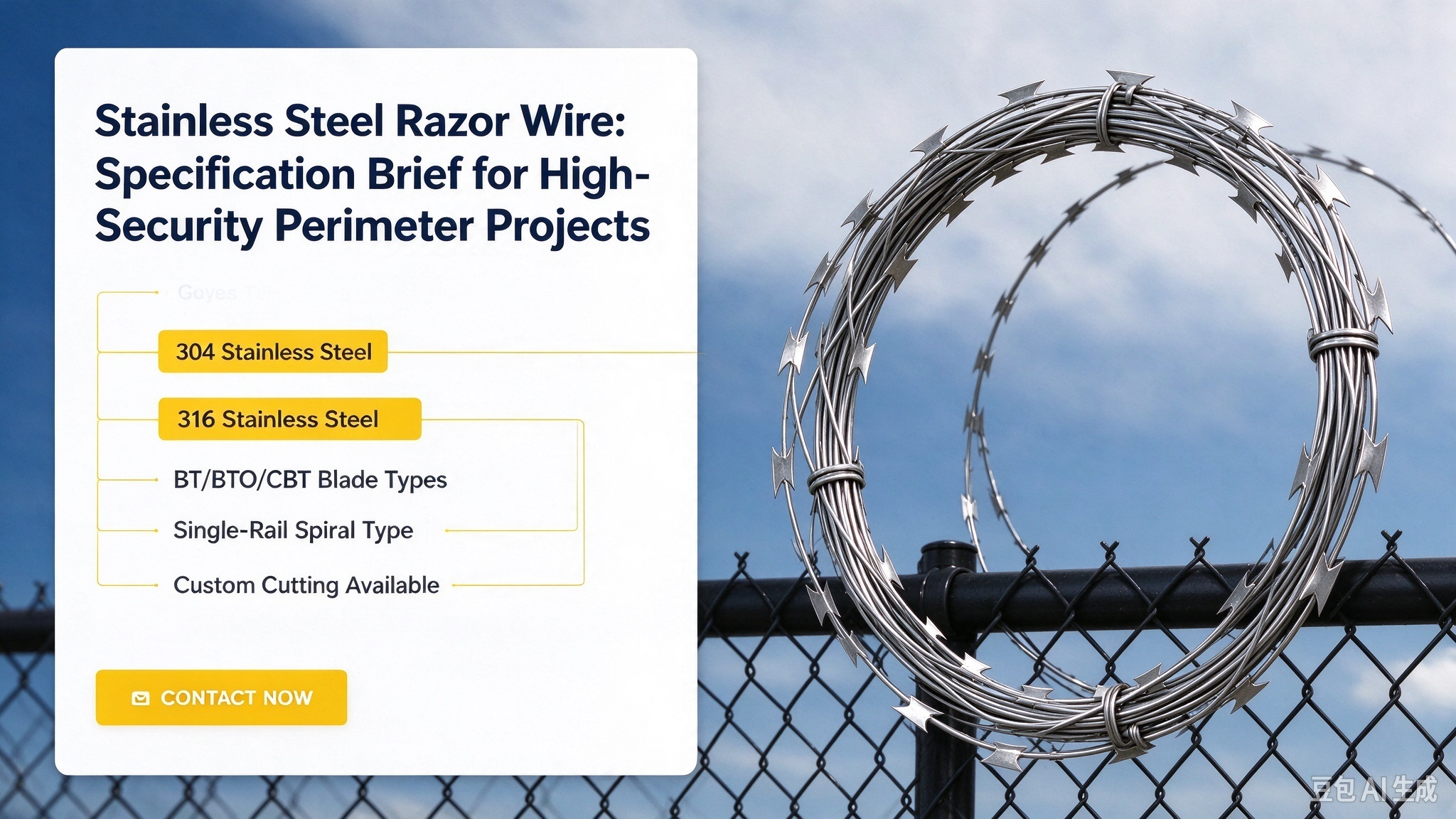
The most consequential specification decision for razor wire buyers is material grade. The product listing for this stainless steel razor wire specifies 304 or 316 stainless steel, and the distinction matters far more than most procurement documents acknowledge.
Type 304 is the baseline austenitic stainless steel, offering good corrosion resistance in most atmospheric environments at a lower cost. Type 316 adds molybdenum to the alloy composition, which significantly improves resistance to pitting corrosion, particularly in chloride-rich environments. For projects located near coastlines, port facilities, or industrial zones where salt spray and chemical exposure are routine, 316 is not a premium upgrade. It is a functional requirement.
This distinction has direct lifecycle cost implications. A 304 wire installed in a coastal environment may show surface corrosion within a few years, triggering inspection findings, maintenance requests, and eventual replacement. A 316 wire in the same location extends the service interval substantially, reducing total cost of ownership even at a higher initial price point. For security specifiers writing performance-based specifications, material grade should be tied to environmental exposure class rather than left to the contractor’s discretion.
Blade Configuration and the Deterrence Equation
The product’s blade options—BTO-10, BTO-12, BTO-18, and CBT-65 cross-spiral style—reflect the range of deterrence profiles available to specifiers. BTO blades are the standard configuration for most commercial and industrial perimeter applications, while CBT cross-spiral blades offer a wider, more aggressive profile for high-security installations.
The choice between blade types is not merely a matter of visual deterrence. It affects the wire’s physical performance under attempted breach. Cross-spiral configurations are designed to resist cutting and climbing more effectively than standard spiral coils, making them suitable for border control, detention facilities, and critical infrastructure where the threat model is higher. For project buyers, the specification should be driven by the site’s security classification, not by a generic catalog selection.
Coil Diameter and Coverage Planning
The available coil diameters—300mm, 450mm, 500mm, and 600mm—correspond to different deployment scenarios. Smaller diameters are typically specified for wall-top mounting and fence-line reinforcement where space is constrained, while larger diameters provide greater standoff distance and are used for ground-level perimeter barriers around industrial sites, substations, and logistics yards.
Single-roll lengths of 10–50 meters, with custom cutting available, give project buyers flexibility in planning material quantities. This is particularly relevant for infrastructure projects where installation sequences are phased and excess material represents both cost and storage burden. Suppliers offering custom cutting reduce waste and simplify site logistics—a practical advantage that rarely appears in product brochures but matters to procurement teams managing multi-site rollouts.
Regional Demand Patterns and Sourcing Implications
The global demand picture is not uniform. Asia-Pacific remains the dominant manufacturing and supply hub, with China’s wire mesh clusters providing scale and export capability. Europe is witnessing increased adoption of advanced razor wire solutions in infrastructure and border security projects, with procurement often tied to defense and public safety budgets. North America represents a mature market characterized by stringent security regulations and a preference for durable, high-specification products.
For international B2B buyers, this regional variance has a direct sourcing implication: the supplier’s ability to document material certification, provide consistent blade quality across batches, and support project-specific customization is as important as the unit price. A supplier that can deliver BTO-22 by the container is not necessarily equipped to supply 316-grade CBT-65 cross-spiral wire for a coastal defense project. Buyers should verify production capability against their actual specification requirements, not against a general product catalog.
Conclusion: Specification Is the First Line of Defense
The global razor wire market is growing, but the growth is not evenly distributed across material grades and product configurations. The buyers who will get the most value from their perimeter security investment are those who treat specification as a strategic decision—matching material grade to environmental exposure, blade type to threat model, and supplier capability to project complexity. In an era where critical infrastructure protection budgets are under scrutiny, the cheapest wire is rarely the most cost-effective barrier.
Media Contact:
Foshan Maigaotuo Metal Technology Co., Ltd.
Email: admin@mgtsp.com
Phone: +86-18153438455 / +86-13129109999